
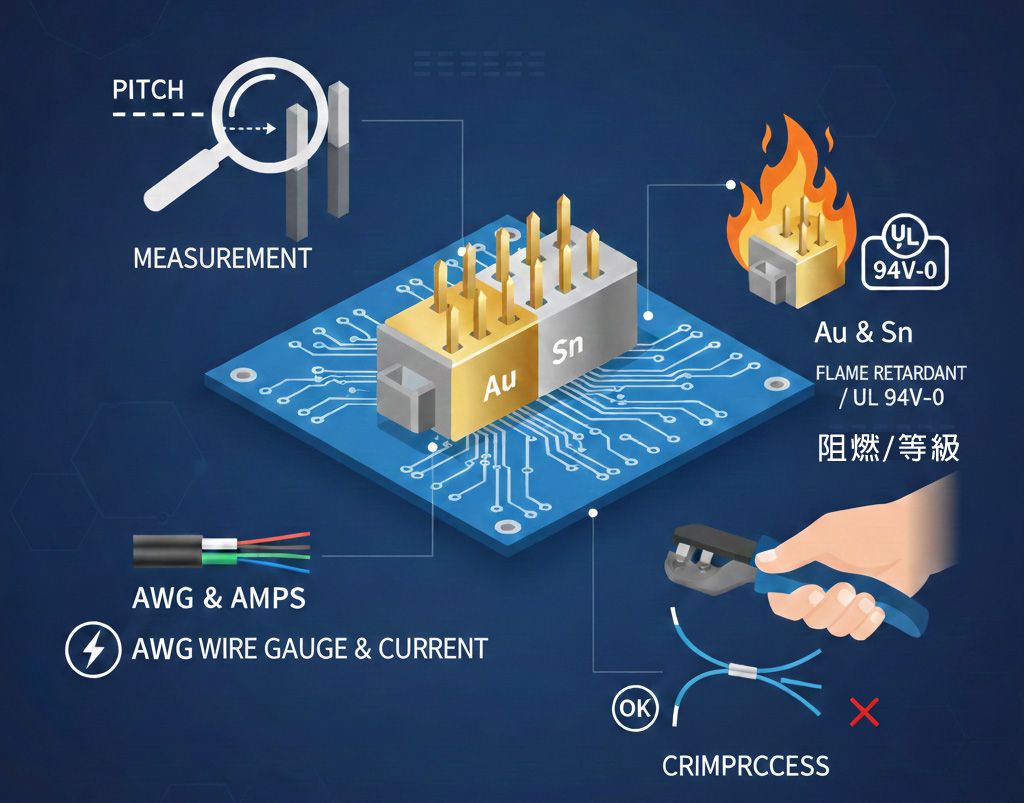
[Technical Guide] Connector Selection and Crimping Applications: 5 Key Technical Q&As
Why can't the crimped terminal be locked into the housing? Will mixing gold and tin plating cause issues? This guide provides an in-depth analysis of connector pitch, wire gauge current ratings, flammability standards, and crimping processes. Master the essential connector fundamentals required by engineers in just 5 minutes, and effectively troubleshoot common production site challenges.
Q1: How to accurately measure connector "Pitch"?
Pitch is defined as the distance between the center points of two adjacent contacts (terminals). TKP recommends the "Average Method" for precise data:
*It is recommended to measure at the base of the terminal to avoid errors caused by tip deformation.
Q2: What is the relationship between AWG wire gauge and terminal current rating?
The smaller the AWG number, the thicker the wire, and the higher the current it can carry. Below are typical reference values used by TKP:
| Wire Gauge (AWG) | Recommended Current |
|---|---|
| 18 AWG | 7.0A - 9.0A |
| 22 AWG | 3.0A - 4.0A |
| 26 AWG | 1.0A - 2.0A |
*Actual capacity depends on temperature rise, terminal material, and insulation thickness.
Q3: Terminal Plating: How to choose between Gold and Tin?
- Tin Plating: Cost-effective with good conductivity. Suitable for dry environments and low mating cycle products.
- Gold Plating: Excellent oxidation resistance and stable contact resistance. Suitable for precision signal transmission or harsh industrial environments.
Q4: What is the Flammability Rating? What does UL 94V-0 represent?
To ensure electrical safety, housings must often comply with UL 94 standards:
- UL 94V-0: One of the highest safety levels; burning stops within 10 seconds without flaming drips.
- Safety Ranking: V-0 > V-1 > V-2 > HB.
Q5: Why can't the crimped terminal be locked into the housing?
This is usually caused by geometric deformation during the crimping process. Please check:
- Crimp height too high: The insulation crimp is too wide, getting stuck at the housing entry.
- Terminal warpage (Banana effect): The terminal bends after crimping, failing to align with the slot.
- Damaged Lance: The locking lance is flattened, losing its ability to secure the terminal.